The Role of Technology in Modern Cosmetic Dentistry

Cosmetic dentistry has always lived at the intersection of art and biology. Patients rarely walk into a practice asking for a millimeter of enamel contouring or a specific ceramic opacity. They ask for a smile that looks less tired, less uneven, less aged, or simply more like the version of themselves they carry in their head. The dentist’s job is to translate that wish into something durable, healthy, and believable. Technology has changed that translation process at nearly every step.
What has shifted most is not just speed or convenience, though both matter. The real change is control. Modern tools allow dentists to diagnose more precisely, design more predictably, communicate more clearly, and execute treatment with less guesswork. For patients, that often means shorter appointments, more comfortable procedures, and results that are easier to preview before any irreversible work begins. For clinicians, it means fewer surprises and tighter margins for error.
That said, technology does not replace judgment. A scanner cannot decide whether a patient’s ideal smile would look natural with their face. Software cannot fully account for lip mobility, personality, speech patterns, or the way light behaves on a restoration in real life. The best cosmetic outcomes still come from clinicians who know when to trust the tools and when to override them.
A field shaped by visibility and precision
Cosmetic dentistry is unusually unforgiving because the work is visible. A small discrepancy that would go unnoticed on a molar can look obvious on a central incisor. A crown that is technically acceptable can still fail aesthetically if the surface texture is flat, the incisal edge is too sharp, or the shade matches under operatory light but not in daylight.
Technology helps because it reduces subjective guesswork in a field where tiny variables matter. Shade selection, smile symmetry, gingival contour, tooth proportion, bite relationship, and facial balance all influence the final result. Many of these factors used to rely heavily on two-dimensional photographs, stone models, and the clinician’s eye alone. Those methods still have value, but digital tools make them more reliable.
In practical terms, the modern cosmetic workflow often starts long before a handpiece touches a tooth. It begins with gathering accurate digital records and building a treatment plan patients can understand. That front-end precision has changed the back end of care.
Digital imaging changed the first conversation
One of the most visible shifts in cosmetic dentistry is the use of high-resolution digital photography and video. Good photography is no longer a luxury in aesthetic treatment. It is a diagnostic instrument.
A still image freezes details that both patient and dentist can miss in a conversational exam. Midline cant, uneven gingival levels, incisal wear, asymmetry in smile arc, and tooth display at rest all become easier to discuss when seen on a large screen. Video adds another dimension because smiles are dynamic. A patient may show very little tooth at rest but a great deal during speech or laughter. That matters when planning veneers, bonding, orthodontic refinement, or gingival reshaping.
This visual record also improves communication with the dental laboratory. A ceramist working from impressions alone can produce competent restorations. A ceramist working from calibrated photos, shade maps, close-ups of adjacent teeth, and videos of lip movement can produce restorations that disappear into the smile.
There is also a psychological benefit for patients. Many people feel self-conscious discussing their teeth. Images make the conversation more objective. Instead of saying, “Your lateral incisor looks short,” a dentist can point to a photo and explain how the neighboring tooth affects balance and why a minor adjustment could create harmony. It feels less like criticism and more like collaborative design.
Intraoral scanners made accuracy easier to repeat
Conventional impressions still have a place, but intraoral scanners have transformed the daily experience of cosmetic dentistry. Anyone who has watched a patient fight a tray full of impression material understands why the shift matters. Scanners are more comfortable, cleaner, and in many cases more precise for aesthetic workflows.
Accuracy in Cosmetic Dentistry is not just about the fit of a crown or veneer. It is also about repeatability. A digital scan captures tooth shape, gingival contours, contact areas, and preparation details in a format that can be stored, rechecked, enlarged, and transmitted instantly. If a restoration needs revision months later, the original file is often available without the need to start from scratch.
For veneer cases, scanners can be especially useful in preserving fine margin detail and enabling mockups that translate well from plan to provisional to final restoration. For aligner-based pre-restorative orthodontics, digital models allow clinicians to compare stages of movement in a way that is difficult with plaster casts stacked on a shelf.
There are limits. Subgingival margins, blood contamination, reflective surfaces, and limited access in posterior regions can still challenge scanners. Skill matters. A poor scan is still poor data, just delivered in a more modern format. Yet when used well, digital impressions reduce remakes and improve consistency.
Smile design software is powerful, but it needs restraint
Digital smile design has become one of the most discussed tools in cosmetic practice, and for good reason. It allows the dentist to overlay proposed tooth shapes onto facial photographs and videos, helping patients visualize changes before treatment begins. Used properly, this can improve informed consent and reduce miscommunication.
The value is not in promising a perfect simulation. No experienced clinician should present smile design software as a guarantee. Teeth are three-dimensional structures viewed through moving lips in changing light, and software mockups are still approximations. Their real value lies in planning and communication. They help answer questions early: Should the central incisors be lengthened? Is the midline discrepancy worth correcting? Would broader buccal corridors suit the face, or would that look artificial? Is gum display the real issue, rather than tooth color or shape?
The strongest clinicians use these tools to start a deeper conversation, not to end one. A patient may initially request very white, very square veneers because that is what they have seen online. A digital preview can reveal that a softer line angle and less brightness would suit their age, skin tone, and facial features more naturally. Technology can therefore moderate unrealistic expectations rather than feed them.
The danger appears when software templates override anatomy and individuality. Not every smile benefits from the same proportions. Slight asymmetries are often part of what makes a smile believable. Overdesigned dentistry can look correct on a screen and strangely lifeless in person.
CAD/CAM compressed the timeline
Computer-aided design and computer-aided manufacturing, commonly grouped as CAD/CAM, have had an enormous practical impact on restorative cosmetic care. In the past, many aesthetic restorations required multiple appointments separated by laboratory turnaround. Today, some crowns, inlays, onlays, and selected veneers can be designed and milled in-office on the same day.
For patients, this can mean fewer injections, no temporary restoration, and less time away from work. For clinicians, it creates tighter control over the process. A digital design can be adjusted chairside, milled, tried in, modified, and bonded without the delays of shipping models and waiting for lab returns.
The time savings are real, but this is one area where marketing often gets ahead of judgment. Same-day treatment is not automatically better treatment. Complex anterior cases, especially those involving multiple veneers in the smile zone, often benefit from the artistry of a highly skilled ceramist. Layered porcelain fabricated in an excellent laboratory can achieve a depth, fluorescence, and surface character that many chairside-milled restorations still struggle to match in demanding cases.
That trade-off matters. If a patient needs a single molar crown, speed may dominate the decision. If a patient wants six upper veneers that must look natural in close conversation and photography, artistry may matter more than finishing in one visit. Technology gives options. It does not erase hierarchy of indications.
3D printing brought planning into the operatory
3D printing has expanded quickly in cosmetic dentistry because it fills a practical gap between digital planning and hands-on treatment. Dentists can print models, surgical guides, whitening trays, retainers, provisional restorations, and mockups with remarkable speed. This is especially useful when treatment involves staged changes, such as orthodontics before veneers or implants in aesthetically sensitive areas.
One of the most patient-friendly uses of 3D printing is the trial smile or mockup. After digital planning, a dentist can transfer the proposed shape into the mouth temporarily, usually with a matrix or printed guide and provisional material. That lets the patient see and feel the planned contours before definitive treatment begins. They can assess speech, lip support, length, and general appearance in a way that no screen image can fully convey.
This step has saved many cases from mismatch in expectations. A patient may love the look of slightly longer incisors on a photo but feel that the same design interferes with certain speech sounds once tried in the mouth. Adjusting a mockup is much easier than regretting a final ceramic case.
The economics are changing too. Equipment and materials still require investment, but in-house printing has become more accessible. Practices that use it well often become more efficient not because each device is flashy, but because the entire workflow becomes tighter.
Lasers refined soft tissue aesthetics
Not every cosmetic improvement involves the teeth themselves. Gingival architecture can make or break a smile. A tooth that appears short may actually be hidden by excess gingival tissue. Uneven gum levels can create asymmetry even when the teeth are structurally sound. Here, soft tissue lasers have become valuable tools.
Lasers can be used in selected cases for gingival recontouring with less bleeding and often a more comfortable recovery than traditional methods. In the right hands, they help create more balanced gingival margins around veneers, bonding, and crowns. They are also useful when refining the frame around a restored smile, especially in patients with altered passive eruption or minor contour irregularities.
Still, lasers are not magic wands. Biological width, underlying bone position, periodontal health, and case selection remain critical. A clinician who reshapes tissue without understanding these factors can create relapse or chronic irritation. The technology improves execution, but it does not replace periodontal principles.
Whitening became more precise and more controlled
Tooth whitening is among the most requested cosmetic treatments, and technology has made it more customizable. Digital shade analysis, better tray fabrication, improved peroxide formulations, and desensitizing protocols have all made whitening more predictable than it once was.
One of the more practical benefits is sequencing. In a modern cosmetic plan, whitening can be integrated before bonding or ceramics so that final restorations match the patient’s brighter baseline. This sounds simple, but it avoids a common problem from earlier eras, when restorations were placed first and natural teeth later became lighter, leaving a mismatch.
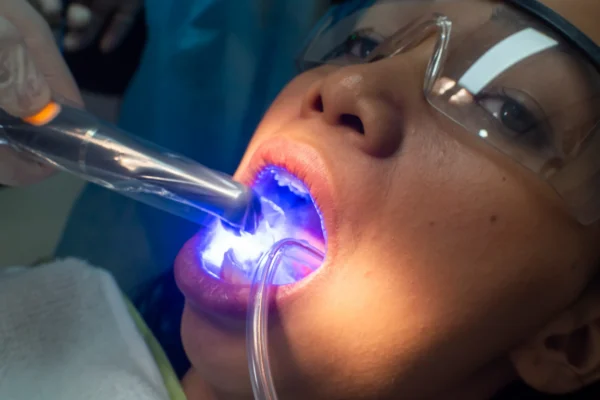
Technology also helps manage sensitivity, which is one of the main reasons patients abandon whitening. Better-fitting trays from digital models reduce gel overflow onto soft tissues. Products with potassium nitrate, fluoride, or other sensitivity-management ingredients improve compliance for many patients. Chairside light systems are still marketed aggressively, but their benefits vary. The chemistry does the heavy lifting. The experienced dentist knows that not every bright lamp leads to a better result.
Clear aligners changed cosmetic case sequencing
Many cosmetic cases are not purely restorative. Teeth may be crowded, rotated, worn unevenly, or positioned in a way that would require aggressive reduction if corrected with veneers alone. Digital orthodontic planning, especially through clear aligner systems, has changed how dentists approach these situations.
A short phase of tooth movement can reduce the need for drilling, improve symmetry, and create space for conservative bonding or veneers. This is one of the most meaningful ways technology supports better cosmetic outcomes while preserving healthy enamel. Rather than forcing restorations to mask underlying alignment problems, clinicians can reposition the teeth first and restore more minimally afterward.
This is not always the fastest route, and it requires patient buy-in. Some people come seeking immediate change and lose enthusiasm when told that three to nine months of alignment could improve the final result substantially. Yet in many of the best aesthetic cases, restraint at the beginning prevents over-treatment at the end.
Materials science matters as much as machinery
Technology in cosmetic dentistry is not only digital. Advances in materials have been just as important. Modern ceramics, composite resins, bonding agents, and cements have broadened what is possible while improving longevity and appearance.
Lithium disilicate, zirconia variants, and improved porcelains offer different balances of strength and translucency. High-quality composites polish better and hold luster longer than older generations. Adhesive systems continue to evolve, allowing clinicians to bond restorations and direct resin more predictably when enamel is preserved.
Material choice remains a clinical judgment call. A highly translucent ceramic may look beautiful in a patient with clean underlying tooth color and favorable bite forces. The same material may fail aesthetically or structurally in a patient with dark stump shades, parafunction, or limited preparation space. Technology expands the menu, but not every material suits every mouth.
Diagnostics became deeper, not just faster
Cone beam computed tomography, or CBCT, is not necessary for every cosmetic case, but when implants, significant asymmetry, root position concerns, or complex interdisciplinary planning are involved, it can be invaluable. Three-dimensional imaging reveals bone volume, root angulation, impacted teeth, and anatomical constraints that would be easy to underestimate on standard radiographs.
This becomes particularly relevant when cosmetic dentistry overlaps with implant placement in the front of the mouth. An implant may integrate perfectly and still look poor if positioned too far facially or apically. Modern imaging and guided planning reduce that risk. In visible areas, fractions of a millimeter can influence papilla support, emergence profile, and long-term tissue stability.
Again, the lesson is not that every patient needs advanced imaging. It is that modern dentistry can apply it selectively where the consequences of missing information are high.
Better communication often matters more than better equipment
One of the least glamorous but most important effects of technology is improved communication among dentist, specialist, laboratory, and patient. Shared digital records, cloud-based case files, annotated photographs, and virtual consultations have reduced the old pattern where key aesthetic decisions got lost between appointments and mail shipments.
When a periodontist can review the planned restorative endpoint before crown lengthening, treatment becomes more coordinated. When a ceramist sees the provisional restorations the patient already approved, the odds of a successful final insertion increase sharply. When a patient receives visual comparisons instead of vague descriptions, consent becomes more meaningful.
A cosmetic case often succeeds or fails in these handoffs. Expensive equipment inside a disconnected workflow is far less useful than modest equipment used by a team that communicates clearly.
Where technology can mislead
It is tempting to talk about innovation only in positive terms, but experienced clinicians know the weak spots. Some practices overpromise because digital previews look polished. Some patients assume a scan and a mill can substitute for careful diagnosis. Some clinicians adopt devices before they master the fundamentals the devices depend on.
A few recurring risks deserve attention:
- Speed can encourage overtreatment when a slower, staged plan would preserve more tooth structure.
- Visual simulations can create false certainty about results that remain partly subjective and biologic.
- New materials can be used outside their ideal indications because they are fashionable or heavily marketed.
- Data quality can suffer when staff are rushed, poorly trained, or dependent on software defaults.
- Patients may confuse convenience with excellence, especially when same-day treatment is promoted aggressively.
These are not arguments against technology. They are reminders that cosmetic dentistry is still a clinical discipline, not a software demo.
What patients should look for in a modern cosmetic practice
Patients do not need to become experts in scanners, printers, or ceramics, but they should know how to evaluate a practice that advertises advanced cosmetic care. The most reassuring sign is not a wall of devices. It is a thoughtful process. A careful cosmetic dentist usually documents the case thoroughly, discusses several options, explains trade-offs, and shows a clear rationale for the chosen approach.
It is also worth noticing whether the conversation includes function. The best cosmetic work respects bite forces, enamel preservation, gum health, and long-term maintenance. If every problem is answered with veneers after a brief exam, something is missing.
A useful practical checklist is short:
- Ask to see before-and-after cases similar to your own, not just dramatic transformations.
- Ask whether a mockup or provisional preview is possible before final treatment.
- Ask how the dentist decides between bonding, whitening, orthodontics, and veneers.
- Ask what maintenance the result will require over five to ten years.
- Ask who fabricates the restorations and how the dentist communicates with the lab.
Those questions often reveal more than a long discussion of equipment brands.
The future is more conservative, not just more digital
The most encouraging direction in modern Cosmetic Dentistry is not simply that tools are becoming more advanced. It is that many of those tools support more conservative care. Better planning, clearer simulations, pre-restorative alignment, and stronger adhesive techniques all help dentists preserve natural tooth structure whenever possible.
That is a meaningful shift. Older cosmetic approaches too often relied on aggressive reduction because it solved several problems at once: color, shape, and alignment. Today, a combination of whitening, enamel recontouring, orthodontic refinement, and additive bonding can sometimes deliver a striking improvement with little or no removal of healthy tooth tissue. When veneers are appropriate, they can often be thinner and more precise because the digital setup has done more of the problem-solving in advance.
This matters because cosmetic dentistry is rarely a one-time event over a lifetime. Restorations age, margins wear, patients grind, gums change, and tastes evolve. The more natural structure preserved at the start, the more options remain later.
What technology cannot replace
For all the gains, the final aesthetic result still depends on human judgment. Knowing where to place an incisal edge is one thing. Knowing when not to chase perfect symmetry is another. Some of the most beautiful smiles have tiny irregularities that signal authenticity. Overcorrected teeth can look sterile, even if they score well by every design rule.
Technology can measure width-to-length ratios, but it cannot fully read character. It cannot feel how a patient lights up when a mockup finally looks like them. It cannot decide whether the faint translucency at the edge of a lateral incisor should be preserved because it reflects youth and individuality. These choices come from experience, listening, and restraint.
That is why the role of technology in modern cosmetic dentistry is best understood as amplifying skilled care, not replacing it. The scanner captures the details, the software previews the possibilities, the printer builds the prototype, the mill shapes the restoration, and the imaging clarifies the anatomy. But the dentist still must decide what beauty means in that specific face, in that specific mouth, for that specific person.
When technology Cosmetic Dentistry serves that purpose, the field becomes more precise without becoming mechanical. The smiles look better, the treatment is more efficient, and the results hold up under closer scrutiny. Not because machines have taken over the work, but because the right tools have made thoughtful dentistry easier to deliver.
Toothworks of Bakersfield, Dentist and Orthodontist
1030 H St #1, Bakersfield, CA 93304, United States
+1 661-323-9421
FAQ About Cosmetic Dentistry
Is bonding better than veneers?
Neither option is best for everyone. Composite bonding can address small chips, gaps, or shape concerns and is generally easier to repair. Porcelain veneers may offer greater resistance to staining and wear, but often require removal of some enamel. A dentist should assess your oral health, bite, goals, and budget before recommending treatment.
How long will dental bonding last?
Bonding commonly lasts about three to ten years before it needs repair or replacement, though this varies with the location and amount of bonding, your bite, and daily habits. Regular dental visits, good oral hygiene, and avoiding chewing hard objects can help protect it. Ask your dentist what lifespan is realistic for your particular treatment.
What are the risks of teeth whitening?
Whitening can cause temporary tooth sensitivity and gum irritation. Overuse or incorrect use may damage teeth or gums, and whitening does not change the color of existing crowns, veneers, or fillings. Have a dentist assess your teeth and gums, and follow the recommended product directions and treatment schedule.